
Finding Escambia County Residents
Begin with the record that fits the question. For a current address, the Escambia County Property Appraiser accepts an owner name, location address, account number, or parcel number. For a person tied to a recorded transaction, the Clerk's LandmarkWeb index searches names across deeds, mortgages, liens, plats, and other instruments. An individual voter check uses identifying details through the Supervisor of Elections. Older occupants may instead appear in Pensacola city, telephone, and cross directories at the public library.
No single roll lists every Escambia County resident. Property files identify owners and mailing contacts, not all occupants. Voter tools cover registered voters and are not open street rosters. Court indexes document cases, not residence by themselves. A sound search therefore follows several records and compares middle names, dates, parcel details, and known relatives before treating two entries as the same person.
Start with the most specific fact available. A full street address can be normalized through the parcel map before a name is searched. A full name becomes more reliable when paired with a middle initial, age range, spouse, business role, or known transaction. For an older search, keep the historical street name and legal description because house numbers can change. Write down each source date as well. Tax rolls, registrations, filings, and directory volumes describe different moments, and a match from one year should not silently be carried into another.
- Check the county property roll by owner name or location address.
- Use the official voter self-lookup when the required identifying data is known.
- Search LandmarkWeb by the confirmed owner name, then inspect deed and lien details.
- Ask Pensacola Library staff for city or reverse directories when the question concerns an earlier household.
- Send a narrow Chapter 119 request to the correct custodian when the needed record is not online.
Escambia County Directory Offices
Three elected offices anchor most Escambia County residents directory work. The Clerk records land instruments and also keeps Circuit and County Court files. The Property Appraiser publishes the tax roll and parcel map. The Supervisor of Elections handles registration verification and election-record requests. Each office answers a different question. The Escambia County street directory explains the full address route, while these contacts help identify the right custodian.
Clerk Official Records
221 Palafox Place, Suite 110
Pensacola, FL 32502
850-595-3930
Supervisor of Elections
213 Palafox Place, Second Floor
Pensacola, FL 32502
850-595-3900
Escambia Property Roll First
LandmarkWeb is mainly indexed by a person's name, so an address works better after it has been resolved in the Property Appraiser system. The parcel result supplies the owner, situs address, mailing address, legal description, subdivision, assessed values, exemptions, and links to maps or sales. A situs address is the physical place being researched. The mailing address is where the tax notice goes, and it may belong to an owner who lives elsewhere.
Carry the exact owner spelling and legal description into the Clerk search. That small step prevents a common dead end and helps separate people with similar names. Homestead status may support an owner-occupancy inference, but it does not name every person in the home. The roll is a starting point, never a complete household list.
The Property Appraiser search screen shows where an owner or address query begins.
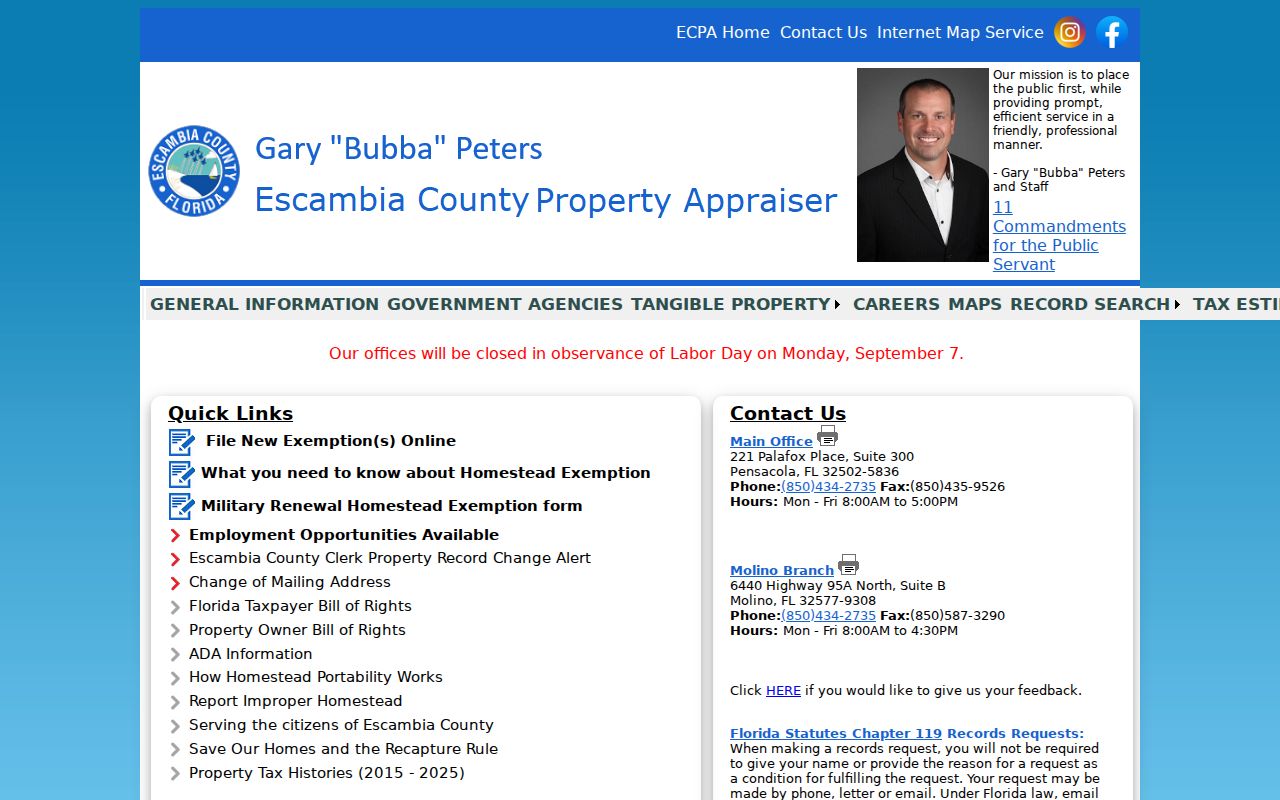
Its parcel records supply the stable land details needed for the next official search.
Escambia Deeds Reach Territorial Days
Escambia County's separate Historical Deed Book Index reaches from 1820 through 1982. That start date predates Florida statehood and makes the recorder trail unusually deep. Newer instruments are searched in free LandmarkWeb by name, document type, book and page, instrument number, record date, or legal description. The index can expose deeds, mortgages, satisfactions, liens, plats, marriage records, and other recorded documents.
A grantor transfers an interest; a grantee receives it. Search both roles to follow a parcel across transactions. An index entry points to the filed instrument, while a certified copy is the custodian's official reproduction. When an image is absent, use the Official Records counter, mail channel, or copy request rather than assuming the record does not exist.
Florida Voter Lookup Limits
The Escambia County registration lookup routes an individual to Florida's voter information tool. It requires identifying information and confirms one person's registration details. It does not provide a public browse of everyone along a road. Florida Statutes sections 97.0585 and 98.0981 govern disclosure, while protected identifiers and exempt addresses remain outside ordinary access.
The Elections Office also accepts a public-records request when a lawful record is not delivered by the self-service screen. Describe the record, date range, and preferred format. Do not ask the self-lookup to perform a block search it was not designed to provide.
The official registration page illustrates the verification route.
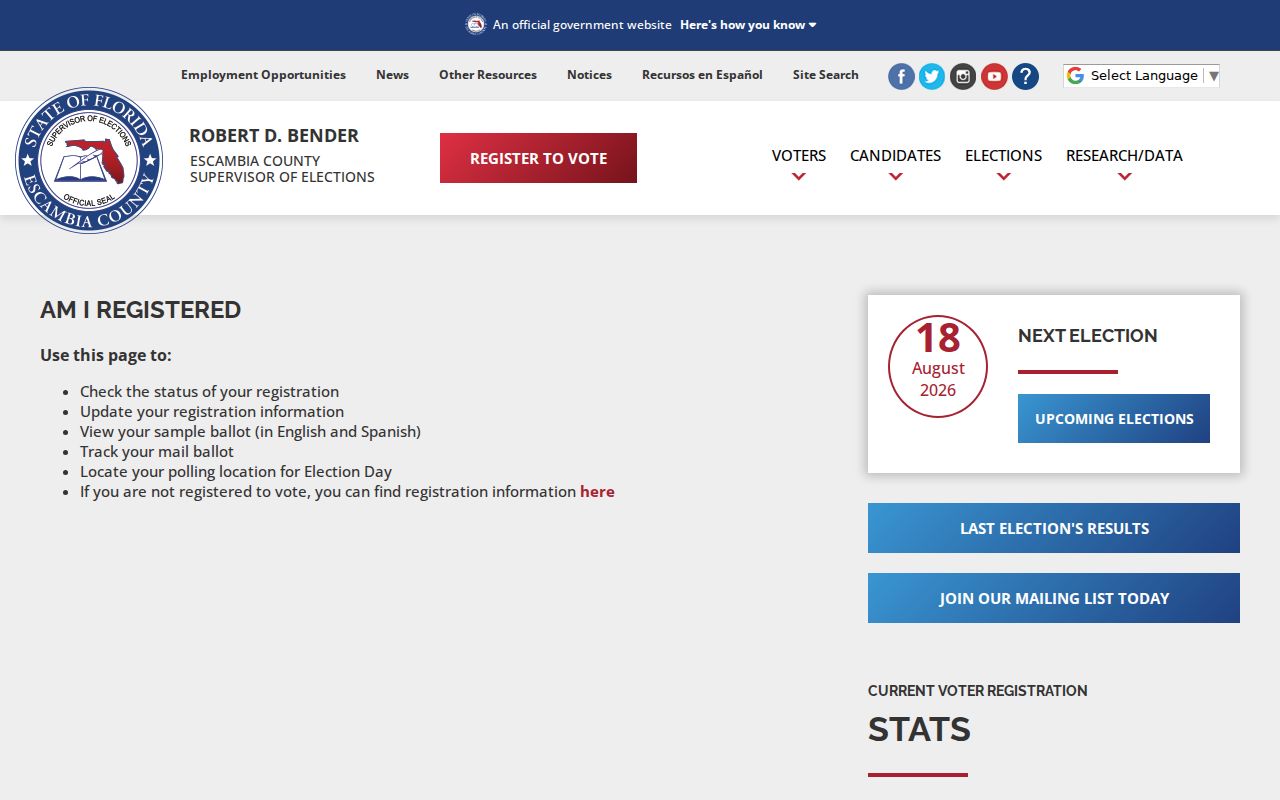
This controlled form helps confirm a known voter without exposing a countywide street directory.
Current Escambia Resident Directories
Current official sources divide people by their relationship to a public record. Owners appear on the tax roll. Parties to recorded instruments appear in the Clerk index. Registered voters can verify their own status, and a court party may appear in CourtView. Public business and professional records add affiliation evidence. None of these sources should be read as a master list of everyone who resides in Escambia County.
| Source | Who It Lists | Keeper | Access |
|---|---|---|---|
| Real-property roll | Owners and mailing contacts | Property Appraiser | Free online |
| Registration verification | One registered voter | Supervisor of Elections | Identifying data required |
| LandmarkWeb | Parties to recorded instruments | Clerk | Free index and available images |
| CourtView | Named court parties | Clerk | Free unofficial index |
| Sunbiz and DBPR | Business principals and licensees | State agencies | Free online |
The best source depends on what must be confirmed. Use the property roll for a parcel-owner link, the deed index for a recorded transaction, and CourtView for a local case. The Escambia County resident lookup gives the one-person verification sequence and safeguards against merging names.
Matching Names in Escambia CourtView
CourtView searches Escambia County Circuit and County Court records by party, case, citation, or agency number. A party query can use last name, first name, middle name, date of birth, and a date range. Results may show the case number, party role, file date, case type, charges or claims, events, and disposition. A disposition is the recorded outcome or status, not a statement about where the party lives today.
Common names demand a second source. Compare the full name and case timing with a parcel, recorded document, or known biographical fact. For copies or material beyond the online index, submit the Clerk's court-record copy and viewing form or ask at the records office. CourtView is an index for cases, not a people directory and not proof that two matching names identify one Escambia County resident.
Escambia Records Beyond Portals
Florida's public-records framework rests on article I, section 24 of the state constitution and Chapter 119 of the Florida Statutes. Escambia County accepts requests online, by phone, in writing, or in person. A requester may remain anonymous and need not state a purpose. The custodian may charge actual duplication costs and a special-service fee when extensive staff time or technology is required.
Specific requests work best. Name the department, address or person, type of record, date range, and desired format. Ask to inspect first when that will answer the question. Pensacola has its own City Clerk route, while unincorporated permit and code records belong with county Development Services. A Pensacola mailing line does not prove city jurisdiction, so confirm the municipality in parcel or GIS data before choosing a custodian.
The county request page lays out the fallback channels.
A narrow request can reach records that a public index does not expose.
Pensacola Records Need City Routing
Municipal records can add an address, applicant, owner, contractor, or public role to an Escambia County search. Pensacola's permit system includes address and map queries for projects in the current platform. The mapped series begins with the November 2019 MyGovernmentOnline cutover, so an empty result may point to the legacy channel rather than prove no permit exists. County Development Services handles unincorporated parcels, and Century keeps its own municipal files.
City permit and code evidence is not an occupant roll. It can connect a person to work at an address, but the named person may be an owner, contractor, applicant, or complainant. Use the Pensacola public-records route for city correspondence, boards, permits, and code matters that are not available through a portal.
The city's public-records page explains how municipal requests are routed.
Checking jurisdiction first keeps a request from landing with the wrong government.
Escambia Vital Record Boundaries
The Florida Department of Health issues birth, death, marriage, and dissolution certifications, while the Escambia Clerk holds marriage licenses and divorce court files. Those products answer different questions. A dissolution certification confirms that an event was indexed; the court file contains the case record. Births less than 125 years old are confidential under Chapter 382, and the cause of death is restricted for 50 years. Marriage and dissolution certifications are generally available to any applicant.
Orders may be made through the state forms and authorized channels, subject to identity and eligibility rules. Use vital records for an event or family link, not as a current residence claim. Probate, deeds, and an obituary can form a lawful path when an estate researcher must identify heirs, but each matching name still needs corroboration.
Escambia Business Name Trails
A resident's name can appear in a business record even when no current home address is public. The Florida Division of Corporations' Sunbiz search covers corporations, limited liability companies, partnerships, fictitious names, liens, and registered agents. Queries may start with an entity name, officer or registered-agent name, document number, street address, or ZIP code. Results can include status, filing date, principal and mailing addresses, officer or manager names, annual reports, and scanned filing images.
These records show a public business role or filing contact. They do not prove that the person lives at the listed address. A registered-agent address may be a law office or commercial service, and a principal address may be a workplace. Match the filing with another official record before connecting it to an Escambia County resident.
The Florida Department of Business and Professional Regulation offers a separate license verification search. It accepts a person or business name, license number, location, county, and profession-specific filters. License status and public business details can distinguish two people who share a name. Profession-specific boards remain the right source when DBPR does not regulate the occupation involved.
Protected Escambia Address Records
Some lawful records are intentionally limited. Florida's Address Confidentiality Program gives eligible survivors of domestic violence, stalking, sexual assault, and related harms a substitute mailing address for interactions with public agencies. Florida Statutes sections 741.401 through 741.465 govern the program. Section 119.071 also creates address exemptions for listed officials and protected people. An absent or substitute address is a safety measure, not evidence that a person has left Escambia County.
Other boundaries depend on the record. Driver and motor-vehicle information is restricted by the federal Driver's Privacy Protection Act and Florida law. Voter files withhold protected identifiers and exempt addresses. Birth certificates within the restricted period require eligibility and identification. Sealed or expunged court material will not appear as an ordinary public file.
Respect those limits. Do not try to defeat a confidentiality program by combining fragments from several portals. When a public record is wrong, correction belongs with the office that created or keeps it. The Property Appraiser, Clerk, Elections Office, court, or health department can explain its own correction process; a commercial search result cannot amend the source record.
Pensacola Library Fills Digital Gaps
Online searches are only part of Escambia County's directory trail. Pensacola Library staff can help locate local city, telephone, and cross directories, maps, newspaper clippings, and licensed genealogy databases. West Florida Genealogical Society volunteers add research help. Some material requires an in-building session, and the exact run of surviving years must be checked against the shelf or catalog.
A cross directory is arranged by street and house number. It can name a listed occupant who does not appear as the parcel owner, which makes it a useful companion to the Property Appraiser and deed index. A telephone directory is usually organized by subscriber name. A city directory may add spouse, occupation, employer, and residence abbreviations. Each format answers a different question.
Record the volume's publisher, year, page, and call number. Then compare the entry with the year before and after. A missing name can reflect a publication gap, an unlisted telephone, a move between canvass and printing, or a military posting. It should not be treated as proof of absence. The Florida State Archives, Library of Congress directory collections, census schedules, and Sanborn maps provide further context when the local shelf stops.
Escambia Alerts and Scam Checks
The Clerk's free Property Notification Service watches for a registered name in newly recorded instruments. It sends notice after a matching filing and does not block fraud. Treat an alert as a prompt to inspect the document and contact the Clerk, not as proof that a transfer is valid. The service is useful because the official record itself can be checked without relying on an unsolicited caller or paid middleman.
Florida's unclaimed-property search is another free official name check. Claims go through the state, which warns against unnecessary advance fees. For either service, start at the government domain, verify details with the custodian, and do not disclose sensitive information to someone who contacts you first.
Use records lawfully. Public indexes support family, estate, property, and civic research; never use an address or identity detail to stalk, harass, or harm anyone.
Historical Escambia Resident Directories
West Florida Public Libraries keeps the most useful local bridge between names and homes. The genealogy collection at Pensacola Library, 239 N. Spring Street, includes local city directories, telephone books, reverse or cross directories, maps, clippings, and research help from staff and West Florida Genealogical Society volunteers. A reverse directory begins with a street and house number rather than a surname, making it valuable for occupants who never owned the parcel.
The known digitized 1907 R. L. Polk & Co. Pensacola volume shows how an entry can encode a name, spouse, occupation, employer, and home address. Printed runs have gaps, abbreviations, and unlisted households, so compare adjacent years and then pair the entry with deeds, the public 1950 census, maps, or newspaper material. Ask staff to confirm the exact publisher and year on the shelf instead of assuming a continuous run. The Escambia County city directory covers those collections in depth.
The library genealogy collection shows the local research services and holdings.
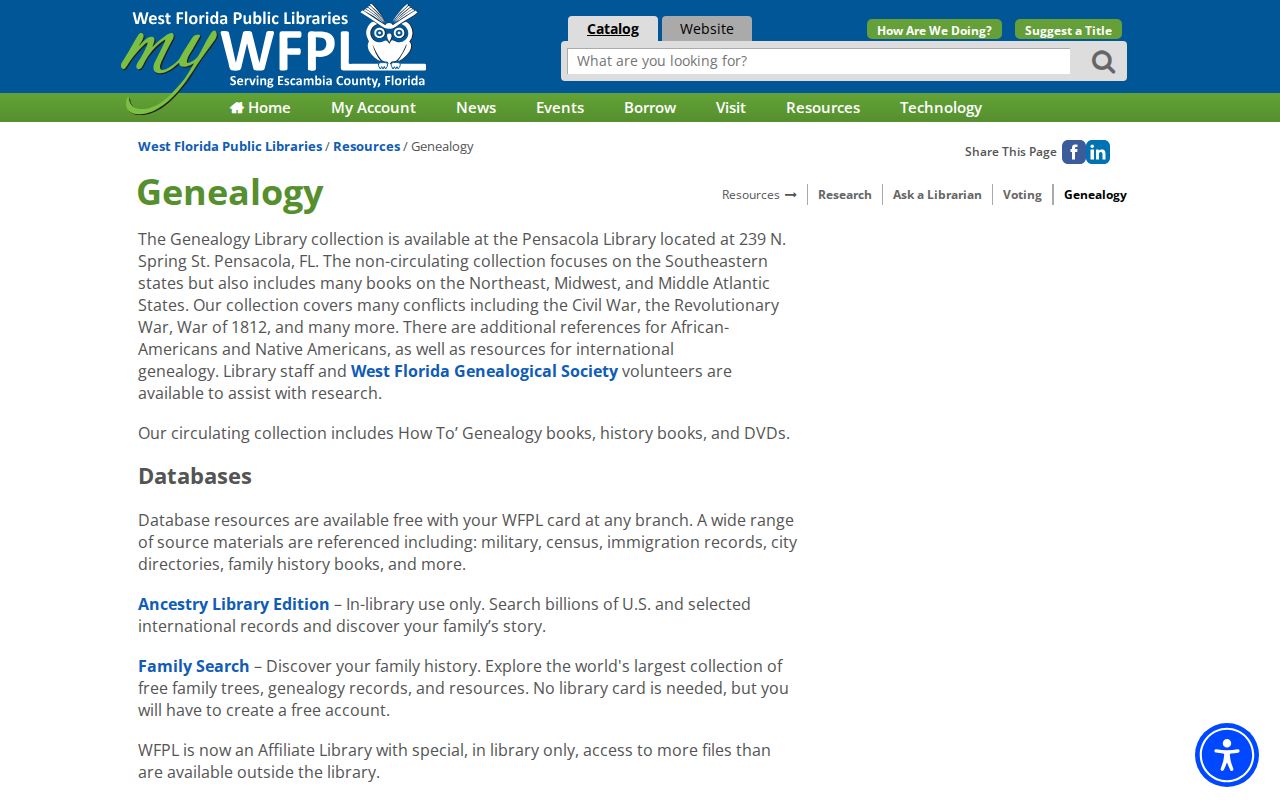
These shelves add listed occupants and street history that parcel ownership alone cannot supply.