
Escambia County Directory Collections
The historical shelf is split among several keepers. The Pensacola Library genealogy collection holds local city, telephone, and cross directories, along with maps and newspaper clippings. University of West Florida repositories provide a verified digital selection. The Hilton-Green Research Room adds city directories dating to 1885, telephone books, cemetery material, microfilm, and manuscripts. These are complementary collections, so a gap in one catalog should lead to the next keeper rather than end the search.
| Collection | Verified years | Where kept | Access route |
|---|---|---|---|
| Pensacola city directories | Selected editions, 1885-86 through 1940 | UWF, Pensacola Library, Hilton-Green | Selected volumes online; physical research onsite |
| Telephone and cross directories | Digitized phone books, 1949-1954; broader run not listed | UWF links and Pensacola Library | Digital selections and onsite shelves |
| Maps and newspaper clippings | Dates vary | Pensacola Library and Hilton-Green | In person, databases, microfilm, staff request |
| Federal census | Public schedules through 1950 | NARA and library databases | Digital indexes and images vary |
| Florida historical records | Territorial and state periods | Florida State Archives | Catalog, digital items, reference request |
The verified digitized editions are 1885-86, 1887-88, 1890-91, 1896, 1900, 1903, 1905, 1907, 1908, 1909, 1910, 1911, 1913, 1916, 1919-20, 1921-22, 1934, and 1940. That list describes surviving or digitized books, not annual publication. Cite the year and publisher shown on the volume itself.
Pensacola City Directory Research Desk
West Florida Public Libraries provides the most direct local starting point. Its genealogy collection is at Pensacola Library, 239 N. Spring Street. The official description names local city directories, telephone books, cross directories, maps, books, and newspaper clippings. Staff members and West Florida Genealogical Society volunteers can help identify a run that is not well described online.
Ask for a surname, address, and approximate date. Also ask whether the edition is on a shelf, on microfilm, or in a licensed database that requires an in-building session. A focused request lets staff check call numbers and nearby years. Exact year runs must be confirmed from the physical holdings because the broad cross-directory span is not published online.
The West Florida Genealogical Society supports local research and volunteer help.
The society connection helps when an index uses an old street name, a variant surname, or a local publication that is hard to identify from afar.
Digitized Pensacola Directory Years
UWF supplies an exact online route into selected Pensacola volumes. One inspected example is R. L. Polk & Co.'s 1907 Pensacola Directory, Volume III. UWF describes entries arranged by surname and also by address and telephone. The book was compiled door to door and may show occupation and spouse. Its front matter reports 13,038 names and estimates a population of 32,595 by multiplying that count by 2.5.
The UWF record for the 1907 Pensacola directory leads to the open volume.
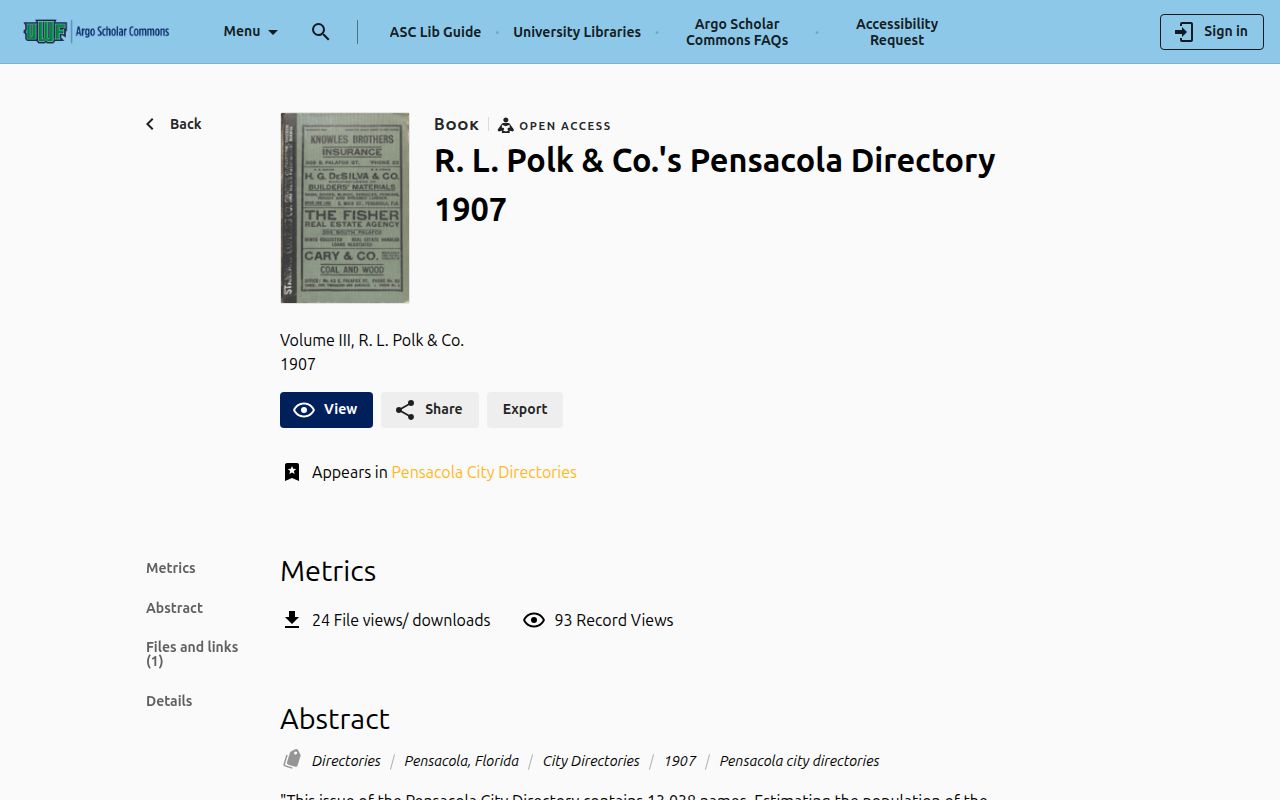
The screen places a title and year behind the search. Record the volume, page, exact entry, and repository URL.
Reading Escambia County Directory Entries
A printed line compresses several facts. Read only what the page and its key support. A surname and initials identify the listed person; a spouse may appear beside that name; an occupation or business may follow; and a house number and street place the entry for that edition. Telephone or address references can point to another section. No single named entry or code key was verified in the research, so unexplored abbreviations must not be expanded by guesswork.
| Name | Surname, given name or initials, and suffix exactly as printed |
|---|---|
| Household clue | Spouse or widow notation when the volume defines it |
| Work line | Occupation or business as a dated identity clue |
| Place | House number, street, and address-section reference |
| Telephone | Listed service only, never all people in a home |
Photograph or cite the title page and abbreviation key first. This keeps a trade code, directional, or residence mark from becoming an unsupported fact.
- Criss-cross directory
- A volume arranged by street and house number rather than only by surname.
- Householder index
- An address-order list of the person named for a dwelling or account.
- Abbreviation key
- The publisher's own list explaining shortened words and symbols.
Pensacola Directories Start at Home
Most genealogy searches begin with a surname. Pensacola's physical cross directories permit the reverse approach: begin with a street and house number, then read the listed occupant or subscriber. This unusual local collection can add renters and other listed residents whom a deed never names. It also helps separate two people with the same surname by placing each at a dated address.
Reverse searching is incomplete. A household may have unlisted telephone service, may be omitted by the compiler, or may have moved during publication. Later cross directories can be phone-derived. Pair a directory line with a census, newspaper notice, deed, or probate source before making a major family-history claim.
Trace Escambia County Family History
Move through the city directory years in small steps. Do not assume a person stayed at one address between two surviving books. Changes in spouse notation, occupation, street, or initials can show a move or help separate names. The public 1940 and 1950 census schedules are useful checkpoints because federal schedules through 1950 are open under the 72-year rule.
- Choose the edition closest to a known Escambia County date and search surname variants.
- Copy the entry exactly, including spouse, occupation, address, and citation.
- Check the street or criss-cross section to confirm how the house was indexed.
- Move to prior and next editions, noting each change instead of filling gaps.
- Pair 1940 or 1950 directory evidence with census, newspaper, probate, or cemetery records.
If the address itself is the subject, the Escambia County street directory keeps modern parcel work separate from this historical workflow.
Escambia County Archive Appointments
The Hilton-Green Research Room at 117 E. Government Street is open Tuesday through Friday, 10:00 a.m. to 4:00 p.m., by appointment. Contact HParchives@uwf.edu or 850-595-5985 ext. 125. Holdings include more than 100,000 images, directories dating to 1885, telephone books, cemetery records, Spanish Land Grants, early-newspaper microfilm, census material, Sanborn maps, and manuscripts.
Personal electronics are restricted, so arrange copying, scanning, and fees in advance. UWF University Archives and West Florida History Center reports about 800 collections, 1.8 million items, 250,000 photographs, and 6,000 maps. Only part is described online. Ask by collection, person, place, and date.
The Florida State Archives adds a catalog and reference route for transferred or territorial records.
This statewide path works best after a local directory supplies a name, year, or agency that can narrow the request.
Escambia County Directory Gaps
A missing entry can mean a move, death, military service, unlisted phone, or compiler omission. Street renaming can also hide continuity. Use maps and legal descriptions to bridge an address change, then search newspaper and obituary files for a dated explanation.
WFPL database coverage includes Pensacola Journal 1905-1985, Pensacola News 1956-1985, Sunday News-Journal 1955-1985, historical PNJ 1985-2012, and a recent file from 2011 with a delay. Microfilm includes Daily News/Journal 1889-1919, PNJ 1954-2019, and selected papers from 1828-1846. Send a precise person, place, and date question to genealogy@mywfpl.com.
Military Families in Pensacola Directories
NAS Pensacola, Corry Station, port work, and federal service shape the local trail. A brief appearance may mark a posting rather than a settled household. County and city offices do not hold complete naval personnel files. Historical unit publications, base newspapers, yearbooks, and NARA records are better channels, while modern personnel and private addresses remain restricted.
Search initials, suffixes, married and maiden names, and spelling variants. Pensacola's Spanish, Gulf Coast, African American, and military history creates many reasons for a name to change form across books. Preserve what each source prints, then reconcile differences with another dated record.